
Water Behind Stucco? 7 Signs of Hidden Water Damage in Arizona
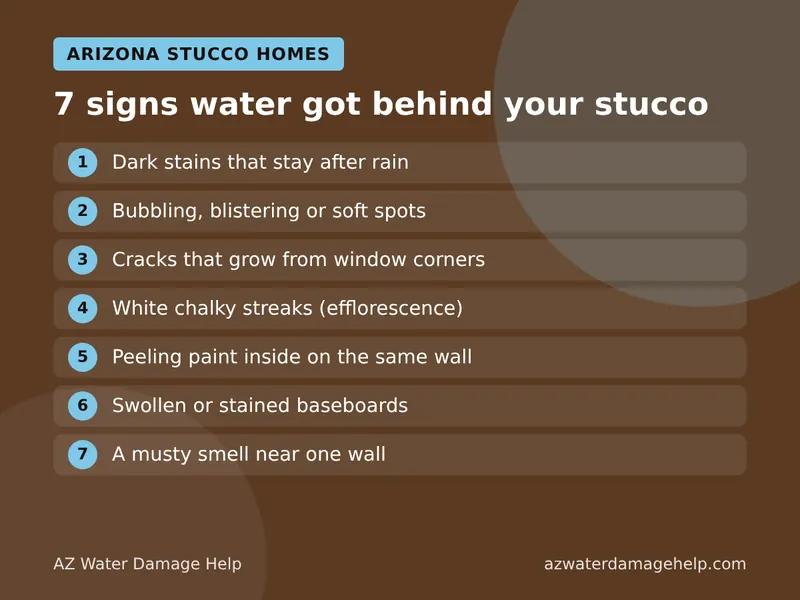
Water behind stucco usually shows up as dark stains that stay after the wall dries, bubbling or soft spots, cracks that grow, white mineral streaks, peeling interior paint, swollen baseboards, or a musty smell on that wall. Most leaks start at windows, roof-to-wall joints and the base of the wall. A moisture meter or thermal camera confirms how far the water spread.
Most Arizona homes built since the 1980s have stucco walls over a wood frame. Stucco handles sun and dry heat well. It is not waterproof, though. It relies on a paper or wrap layer behind it and on flashing at windows and roof edges to send water out. When that layer fails, water can soak the framing for months while the outside looks fine.
The monsoon is when this shows up. Wind-driven rain hits walls sideways, and it can get behind stucco at every crack and window corner. If you already see damage inside, our team handles emergency water extraction arizona homes need and the drying that follows.
Reading this with water on the floor? Get help first.
Need Help Now? Tap Here(833) 937-0179What are the 7 signs of water behind stucco?
The most common signs are dark patches that stay after the rest of the wall dries, bubbles or soft spots that give when you press, cracks that grow or shed sand, white chalky streaks, and inside signs on the same wall: peeling paint, swollen baseboards and a musty smell. Two or more signs in one area are worth a moisture check.
- Stains that stay dark a day or two after rain, often under window corners.
- Bubbling, blistering or soft spots that crumble when pressed.
- Cracks that grow or that run from window and door corners at an angle.
- White streaks (efflorescence), which are minerals left as water moves through the wall.
- Peeling or bubbling paint inside on the same wall.
- Swollen or stained baseboards and carpet tack strip that feels damp.
- A musty smell in one room, often near a window or an outside corner.
Where does water usually get behind stucco?
Water usually gets in where stucco meets something else. Window and door corners are the top spot, because the flashing there is easy to get wrong. Next come roof-to-wall joints, where a missing kick-out flashing sends roof water into the wall. The base of the wall is third, when soil or pavers sit above the weep screed and trap water.
| Entry point | What to look for |
|---|---|
| Window and door corners | Diagonal cracks, stains below the corner |
| Roof-to-wall joints | Stains running down from where a lower roof meets a wall |
| Base of the wall (weep screed) | Soil, gravel or pavers above the metal strip at the bottom |
| Parapets on flat roofs | Cracked caps, stains on the wall below |
| Hose bibs, lights, vents | Gaps or dried caulk around the fixture |
| Irrigation and sprinklers | Spray hitting the wall every day |
If the stains sit under a window, our guide on window leak water damage walks through the checks.
How do pros find water inside a stucco wall?
Pros use a moisture meter, a thermal camera, or both. The meter reads moisture in the drywall from inside. The camera shows cool, wet areas as darker patches across the wall. For a closer look, a small probe hole can test the framing behind the stucco. This maps the wet area so only the damaged section is opened.
Testing matters because water spreads down and sideways inside the wall. A stain the size of your hand outside can mean wet framing several feet wide inside. Our guide to signs of hidden water damage covers the inside clues in more detail.
What does the repair involve?
The fix has two parts. First, the wet area inside is opened, dried and treated for mold if needed, which is restoration work. Second, the stucco and flashing outside are repaired by a stucco or roofing contractor so the leak stops. Patching outside without drying the wall traps the water and lets rot and mold keep growing.
- Map the wet area with a meter and thermal camera.
- Open drywall from inside and remove wet insulation.
- Dry the framing with fans and dehumidifiers for 3 to 5 days.
- Treat mold if it is present and check that the wood is dry.
- Repair the flashing, weep screed or stucco outside.
- Close the wall and paint once readings are normal.
How much does stucco water damage cost to fix?
The drying and inside repair often run about $1,500 to $5,000, similar to a burst pipe with drywall work. If mold has grown in the wall, removal adds about $1,500 to $4,000. The outside stucco and flashing repair is a separate bill from the stucco or roofing contractor and varies a lot by wall size.
| Job | Typical range |
|---|---|
| Drying and dehumidifying (3–5 days) | $1,000 – $3,500 |
| Drying plus drywall repair | $1,500 – $5,000 |
| Mold removal | $1,500 – $4,000 |
We cover stucco homes across the state, from the Valley to the foothills. That includes custom homes in Carefree, where you can call for water damage restoration carefree residents trust, and the high country, where our show low arizona water damage page covers snowmelt against walls.
How do you prevent it?
- Keep soil, gravel and pavers at least 2 inches below the weep screed at the base of walls
- Aim sprinklers and drip lines away from stucco
- Re-caulk window perimeters, light fixtures and hose bibs every few years
- Seal hairline cracks before monsoon season with an elastomeric patch
- Have a roofer check kick-out flashing where roofs meet walls
Dealing with water damage now? Talk to a live person 24/7.
Get Expert Help 24/7(833) 937-0179Frequently asked questions
How do I know if water is behind my stucco?
Look for dark stains that stay after rain, bubbling or soft spots, cracks that grow, white streaks, and inside signs on the same wall like peeling paint, swollen baseboards or a musty smell. A moisture meter or thermal camera confirms it.
Can stucco water damage cause mold?
Yes. Water behind stucco soaks the wall paper, sheathing and framing, and those stay damp in the dark. Mold can start within 24 to 48 hours and grow for months before it shows inside.
Who fixes water damage behind stucco?
Two trades. A water damage company dries the wall and removes damaged drywall and insulation. A stucco or roofing contractor fixes the flashing and stucco so the leak stops.
How much does it cost to repair water damage behind stucco in Arizona?
Drying and inside repair often run about $1,500 to $5,000. Mold removal adds about $1,500 to $4,000. Outside stucco and flashing repair is billed separately by the contractor.

About the author
Noah Miller founded AZ Water Damage Help in Queen Creek to give Arizona homeowners fast, honest water damage help. He writes and updates these guides using public guidance from the EPA, the IICRC, the National Weather Service and Arizona state agencies. More about Noah.
Sources
- National Weather Service Phoenix
- EPA: Mold
- IICRC (Institute of Inspection, Cleaning and Restoration Certification)