
Flooded Basement in Arizona? Cleanup Steps and Costs
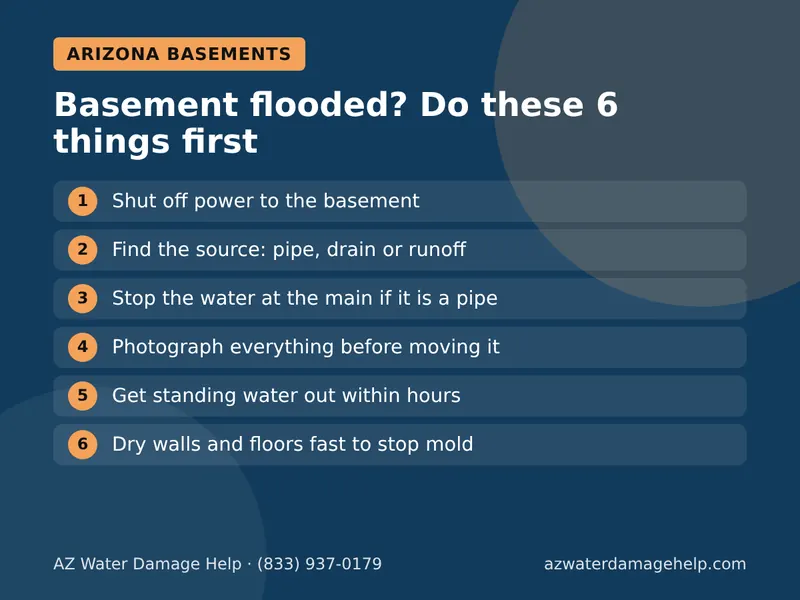
Turn off power to the basement before you step in, find and stop the source, and photograph everything. Then get standing water out within hours. Basements dry slowly because they sit below ground with little airflow, so most need pumping, commercial dehumidifiers, air movers and moisture readings to dry fully and avoid mold.
Most Arizona homes sit on a slab, so a flooded basement is not something many people plan for. But basements are common in Prescott, Payson, Flagstaff and the White Mountains, and you also find them in older homes in central Phoenix and Tucson. When one floods, the water has nowhere to go.
This guide covers what to do in the first hour, what usually floods Arizona basements, how drying works below ground and what cleanup costs. If water is rising right now, our emergency water extraction arizona crews answer 24/7.
Reading this with water on the floor? Get help first.
Need Help Now? Tap Here(833) 937-0179What should you do first when your basement floods?
Make it safe, stop the water, then record it. Turn off power to the basement at the main panel before you walk in, since water can reach outlets, the furnace or the water heater. Find the source and stop it if you can. Take photos and video, then call a water damage company and your insurer the same day.
- Cut the power. If you cannot reach the panel without stepping in water, stay out and call the utility or an electrician.
- Find the source. A burst pipe, a failed water heater, a backed-up floor drain, or rain coming in through a window well or wall.
- Stop it if you can. Shut the main water valve for a pipe or water heater leak. Our guide to the main water shut-off valve shows where to look.
- Photograph everything. Water line on the walls, damaged boxes, furniture and the source itself.
- Move what you can safely carry. Get photos, documents and electronics upstairs. Do not lift heavy wet items alone.
- Get water out fast. Standing water should be pumped and extracted within hours, not days.
What causes basement flooding in Arizona?
The most common causes are plumbing failures, like a burst supply line or a leaking water heater, and storm runoff from monsoon rain or snowmelt that enters through window wells, doors or wall cracks. Sewer or floor drain backups are less common but more serious, because that water is contaminated.
| Source | When it happens | Water type |
|---|---|---|
| Burst or frozen pipe | Winter cold snaps in Prescott, Flagstaff, Payson, Show Low | Clean at first |
| Water heater or softener leak | Any time; many sit in basements | Clean at first |
| Monsoon runoff through window wells or doors | July to September storms | Gray, may carry soil |
| Snowmelt seeping through walls | Late winter and spring in the high country | Gray |
| Floor drain or sewer backup | Clogged lines, heavy storms | Black, contaminated |
Water type changes the job. Clean water left for a day or two can turn gray as it picks up dirt and grows bacteria. Our guide to water damage categories explains why that matters for what can be saved.
How is a basement dried after a flood?
A crew pumps out standing water, extracts what is left from floors and carpet, then sets commercial dehumidifiers and air movers. They take moisture readings in walls, floors and framing each day until materials reach dry standard. Wet carpet pad, insulation and lower drywall are often cut out so the wall cavity can dry.
Basements are harder to dry than rooms above ground. Concrete walls and floors hold water, there is little natural airflow, and the space stays cool. Fans alone just move damp air around. Most basements take about 3 to 5 days with proper equipment, longer if water sat for a while or soaked into finished walls. Our drying time guide covers what affects the timeline.
- Finished basements with carpet and drywall usually need flood cuts, often 2 feet up the wall.
- Bare concrete basements dry faster but still need dehumidifiers.
- Furnaces and water heaters that got wet need a technician before they run again.
What does basement flood cleanup cost in Arizona?
Water extraction usually costs about $500 to $1,500. Drying with equipment runs about $1,000 to $3,500. Most clean water basement jobs land in the $1,000 to $5,000 range with drying and drywall repair. Sewage backups cost more, about $3,000 to $10,000 or more, and mold removal adds about $1,500 to $4,000.
| Work | Approx. cost |
|---|---|
| Water extraction | $500–$1,500 |
| Structural drying (equipment and monitoring) | $1,000–$3,500 |
| Burst pipe cleanup with drywall repair | $1,500–$5,000 |
| Sewage backup cleanup | $3,000–$10,000+ |
| Mold remediation | $1,500–$4,000 |
If mold has already started, you can get a rough number before you call anyone with a mold remediation cost calculator. Our full water damage restoration cost guide breaks down the rest.
Does insurance cover a flooded basement?
It depends on the source. Most homeowners policies cover sudden water damage from a burst pipe or a failed water heater. Surface water from storms and runoff is usually excluded unless you carry flood insurance. Sewer and drain backup is often excluded too, unless you added a backup endorsement to your policy.
- Burst pipe or appliance leak: usually covered as sudden and accidental.
- Monsoon or snowmelt runoff: usually needs a separate flood policy.
- Sewer or drain backup: covered only with a backup endorsement on many policies.
- Slow seepage over months: often denied as maintenance.
Our guide to what Arizona homeowners insurance covers walks through the common exclusions.
How is a basement different from a crawl space flood?
A basement is living or storage space you can stand in, often finished with carpet and drywall, so more of your belongings and finishes get wet. A crawl space is a short space under the floor with exposed framing, insulation and ducts. Both trap moisture, but crawl spaces are harder to reach and basements hold more water.
Many older homes in Prescott, Payson and the White Mountains have a crawl space instead of a basement. If yours does, see our guide to crawl space damage arizona homes.
How can you keep your basement from flooding again?
Keep runoff away from the house and keep plumbing from failing. Clear window wells and add covers, make sure the ground slopes away from the foundation, and point downspouts at least several feet out. Insulate pipes on outside walls before winter. Test any sump pump before monsoon season and check the water heater for rust and drips.
- Clean gutters and extend downspouts before July storms.
- Add clear covers to window wells.
- Seal visible wall cracks and keep soil sloped away from the house.
- Insulate pipes and keep the heat at 55°F or higher in winter, even in an empty home.
- Replace water heater supply lines and check the tank yearly.
- Install a water leak sensor on the basement floor.
Where do we see basement floods most in Arizona?
Mostly in the high country, where basements and freezing winters go together: Prescott, Prescott Valley, Payson, Pine and Strawberry, Flagstaff, Show Low and Pinetop-Lakeside. We also get calls from older homes in central Phoenix and midtown Tucson that were built with basements or cellars.
For local help, see our pages on water damage restoration in Prescott and show low arizona water damage. Payson homeowners dealing with storm water can read our guide to flood damage restoration payson homes. For storm flooding anywhere in the state, see our flood and monsoon damage service.
Dealing with water damage now? Talk to a live person 24/7.
Get Expert Help 24/7(833) 937-0179Frequently asked questions
What should I do first if my basement floods?
Turn off power to the basement before you walk in, find and stop the water source if you can, and take photos of everything. Then call a water damage company and your insurer the same day. Standing water should be out within hours.
How long does it take to dry a flooded basement?
Most basements take about 3 to 5 days to dry with commercial dehumidifiers and air movers. Finished basements with carpet and drywall, or water that sat for days, can take longer.
How much does basement flood cleanup cost in Arizona?
Extraction usually costs about $500 to $1,500 and drying about $1,000 to $3,500. Most clean water jobs fall between $1,000 and $5,000 with drywall repair. Sewage backups cost about $3,000 to $10,000 or more.
Does homeowners insurance cover basement flooding?
Usually yes for a burst pipe or appliance leak. Usually no for storm runoff or snowmelt unless you have flood insurance, and sewer backups often need a backup endorsement. Check your policy.
Can I pump out my basement myself?
You can pump clean water once the power is off and it is safe. But the floor, walls and carpet stay wet after the water is gone. Without dehumidifiers and moisture readings, hidden moisture can lead to mold within a few days.

About the author
Noah Miller founded AZ Water Damage Help in Queen Creek to give Arizona homeowners fast, honest water damage help. He writes and updates these guides using public guidance from the EPA, the IICRC, the National Weather Service and Arizona state agencies. More about Noah.