
Clean, Gray or Black Water? The 3 Categories of Water Damage
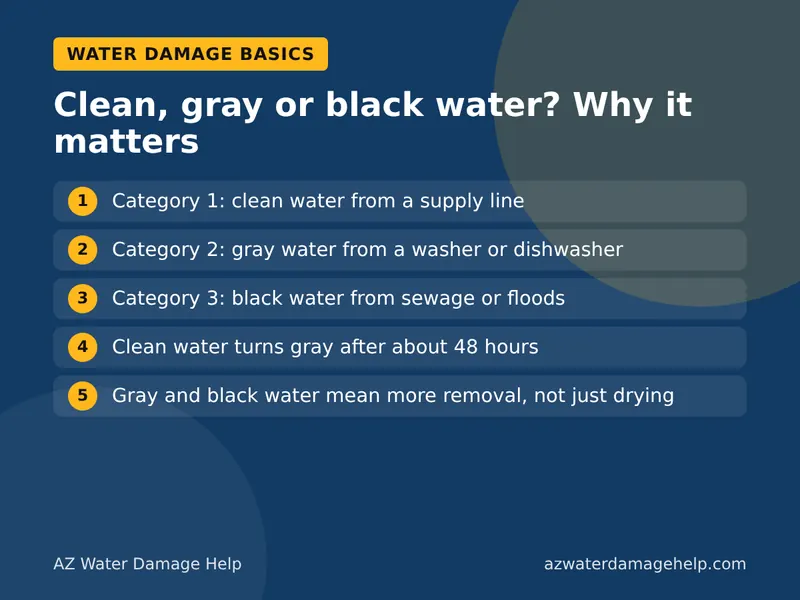
Restoration pros sort water damage into three categories. Category 1 is clean water from a supply line or water heater. Category 2 is gray water from a washer, dishwasher or AC drain. Category 3 is black water from sewage or outside flood water. The higher the category, the more has to be thrown out instead of dried. Clean water extraction often costs about $500 to $1,500, while sewage cleanup runs about $3,000 to $10,000 or more.
When a crew arrives, one of the first things they decide is what kind of water they are dealing with. That choice sets the safety gear, what gets dried, what gets thrown out and how much the job costs. The categories come from the IICRC S500 standard that most restoration companies follow.
If water is spreading now, call our water removal service Arizona line any time, day or night.
Reading this with water on the floor? Get help first.
Need Help Now? Tap Here(833) 937-0179What is Category 1 (clean water)?
Category 1 water comes from a clean source and is not likely to make people sick. Common sources are a broken supply line, a leaking water heater, an overflowing sink or tub with no soap, and a burst pipe. Most items can be dried in place if work starts fast.
- Carpet and pad can often be saved.
- Drywall can often be dried if it is not swollen.
- Wood floors may be saved with fast drying.
For a burst line, see our guide on pipe breaks Buckeye AZ homeowners can handle in the first hour.
What is Category 2 (gray water)?
Category 2 water has some contamination and can cause illness if swallowed or touched for a long time. Common sources are washing machine and dishwasher drains, an AC condensate line, a toilet overflow with urine but no feces, and an aquarium or waterbed. Crews use gloves and disinfect after drying.
- Carpet pad is usually removed.
- Carpet may be cleaned and saved if treated fast.
- Drywall and baseboards are often cut out if they wicked water.
What is Category 3 (black water)?
Category 3 water is grossly contaminated. It can carry bacteria, viruses and chemicals. Common sources are a sewer backup, a toilet overflow with waste, and outside flood or monsoon runoff that crossed yards and streets. Anything soft and porous that it touched is usually thrown out.
- Carpet, pad and upholstered furniture are removed.
- Drywall is cut at least a foot or two above the water line.
- Crews wear protective gear and disinfect every surface.
- Kids, pets and people with weak immune systems should stay out.
See our sewage backup cleanup page for what that job involves.
Can clean water turn into black water?
Yes. Water gets worse over time. Clean water that sits for 48 hours or more, soaks through dirty materials, or sits in a hot Arizona home can move up to Category 2 or 3. Bacteria and mold grow fast in the heat. That is why starting extraction within the first day matters so much.
Once mold starts, the job changes. Our water damage mold removal page explains what happens next.
How does the category change the cost?
Higher categories need more removal, more disinfecting and more rebuilding. Typical Arizona ranges from our cost table:
| Job | Typical range |
|---|---|
| Water extraction, small area | $500 – $1,500 |
| Drying and dehumidifying (3–5 days) | $1,000 – $3,500 |
| Sewage (Category 3) cleanup | $3,000 – $10,000+ |
| Mold remediation, small area | $1,500 – $4,000 |
Your exact price depends on square footage, the water category and what has to be rebuilt.
Who decides the water category?
The restoration crew decides on site, based on where the water came from, how long it sat and what it touched. They note it in the moisture report with photos, which your insurance adjuster will also read. If you are not sure of the source, tell the crew everything you saw, such as a smell, the color of the water, or whether a toilet or floor drain backed up. When in doubt, pros treat the water as the higher category to keep everyone safe.
The category can also be different in two parts of the same home. A washer hose that floods a laundry room is Category 2 there, but if that water runs into a dirty garage and sits for a few days, the garage may be handled as Category 3.
What should you do before the crew arrives?
Stop the water at the source or the main valve. Shut off power to wet rooms from a dry spot. Keep people and pets out if the water is gray or black. Do not use a household vacuum on sewage. Take photos for insurance, and do not throw anything out until it is documented.
Crews serve the whole state, including Pinal County. See water damage restoration Maricopa AZ for local details.
Dealing with water damage now? Talk to a live person 24/7.
Get Expert Help 24/7(833) 937-0179Frequently asked questions
What are the 3 categories of water damage?
Category 1 is clean water, Category 2 is gray water with some contamination, and Category 3 is black water from sewage or flood runoff.
Is monsoon flood water black water?
Yes. Outside flood water that crosses yards and streets is treated as Category 3 because it can carry sewage, chemicals and debris.
Can carpet be saved after a toilet overflow?
If the water was clean or only had urine and it was treated fast, the carpet may be saved, but the pad is usually removed. Carpet touched by waste is thrown out.
Does the water category change my insurance claim?
The category changes the cleanup scope and cost. Coverage depends on the cause of the water, so check your policy and document everything.

About the author
Noah Miller founded AZ Water Damage Help in Queen Creek to give Arizona homeowners fast, honest water damage help. He writes and updates these guides using public guidance from the EPA, the IICRC, the National Weather Service and Arizona state agencies. More about Noah.